
Please consider sharing this newsletter with someone whom you appreciate, like or just want to help. If this newsletter has been shared with you by someone who likes you please consider subscribing, our aim is to help you get more of what you want. Just enter your email address at the bottom of this email to get started and you’ll immediately have access to other great articles, tips and techniques – there’s no cost to you, it’s completely at our expense!
Salesmen who used this pattern interrupt above had 40% to 55% more sales than those who didn’t.
A study was conducted in 1999 by the University of Arkansas where students went door to door selling notecards for a charity. First, they would introduce themselves and say they were selling notecards for a local charity and ask the person answering the door if they would like to know the price. In the control group the student(s) would tell prospects who indicated they wished to know the price that the notepads cost $3. In another group when the persona at the door indicated that they wanted to know the price they would tell them that they cost:
“Three hundred pennies,” they would then pause briefly and continue, “That is $3 – you’re getting a bargain.”
Salesmen who used the pattern interrupt above had 40% to 55% more sales than those who didn’t.
Here’s an example of how successful insurance sales reps use this when presenting prices. It is particularly useful for disability insurance policies. Let’s presume you have a policy that costs $100 per month and pays a monthly benefit of $2,500 per month. The client owns or works at a store that specializes in selling golfing goods. How would you present the numbers? What would you say them?
“… so this does everything you want and it only costs $3.28 per day for a $2,500 monthly benefit. That’s a benefit of up to $30,000 per year for just $100 per month. It’s a bargain and cost less than 2 packs of golf balls a week.”
Lets break this down because we’ve added a couple of twists here.
“It only costs $3.28.”
“Only” makes the cost sound trivial and manageable.
“$3.28 per day for a $2,500 monthly benefit.”
$3.28 is an awkward number for mental arithmetic and it doesn’t easily divide into $2,500. On top of that one price is per day and the benefit is per month. Two things happen here:
1) The brain registers the delta, or difference, between $3.28 and $2,500 as being large and it’s being told a low price for a high benefit. Call it anchoring or priming or first impressions (actually its a combination of all 3 and they work to our benefit).
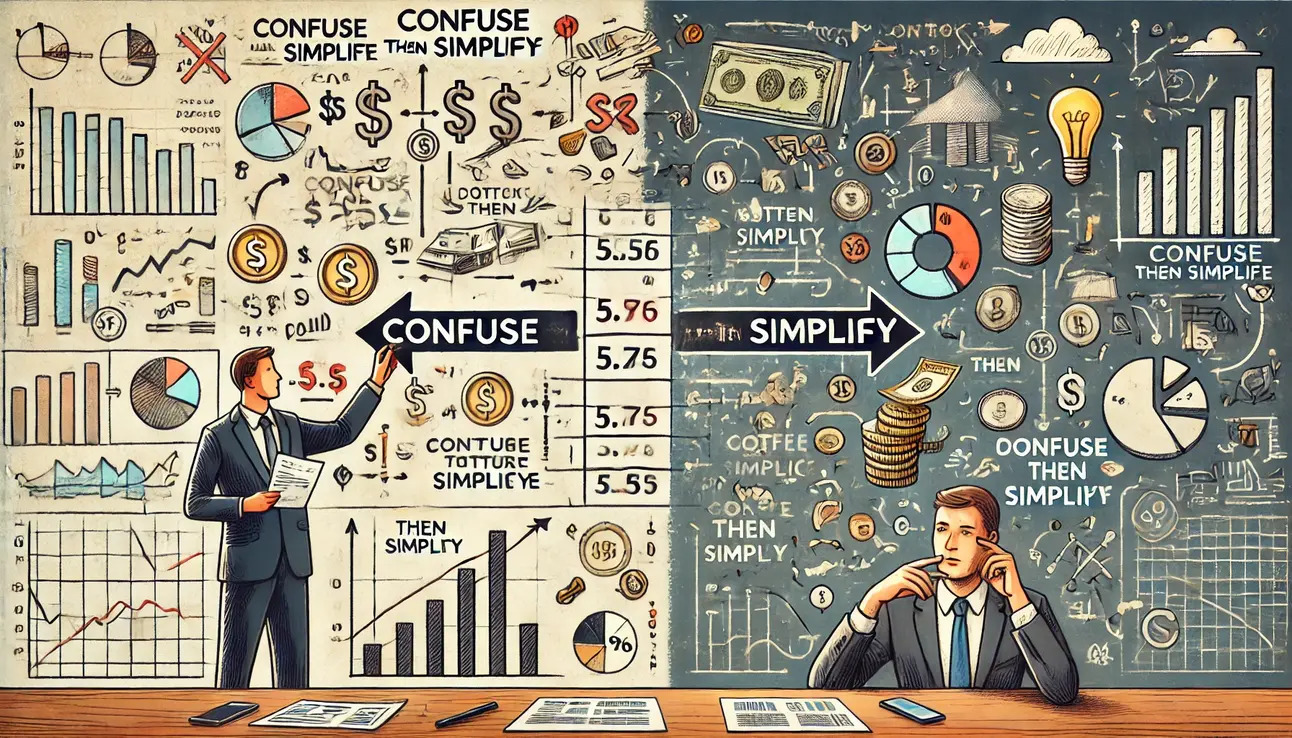
2) Because we are suddenly tasking the brain with performing a minimum of 2 mathematical operations at once neither particularly familiar the critical faculty decreases and voila – pattern interrupt!
“That’s a benefit of up to $30,000 per year for just $100 per month.”
Here we are giving the brain the answer so it doesn’t have to do complicated math. Again, though the benefit is high, the cost is low – because they are round numbers and follow a pattern interrupt the brain won’t balk, get confused or automatically try to do a calculation.
“It’s a bargain.”
The thought or idea is slipped under the radar along with the simpler to understand price.
“and cost less than 2 packs of golf balls a week”.
And this is the piece de resistance. You always want to relate numbers to something the subjects mind understands the value of intuitively (click on the link to see why). Here we reinforce the ‘low cost’ and have given the subconscious mind a strong anchor that this ‘only’ costs 2 packs of golf balls a week.