
Please consider sharing this newsletter with someone whom you appreciate, like or just want to help. If this newsletter has been shared with you by someone who likes you please consider subscribing, our aim is to help you get more of what you want. Just enter your email address at the bottom of this email to get started and you’ll immediately have access to other great articles, tips and techniques – there’s no cost to you, it’s completely at our expense!
“The most influential people aren’t necessarily the most powerful—they’re the ones who build contextually appropriate trust based on relationship needs.”
Table of Contents
Key Points
-
Trust is contextual – it manifests differently depending on the nature and stage of the relationship. Different contexts require different approaches
-
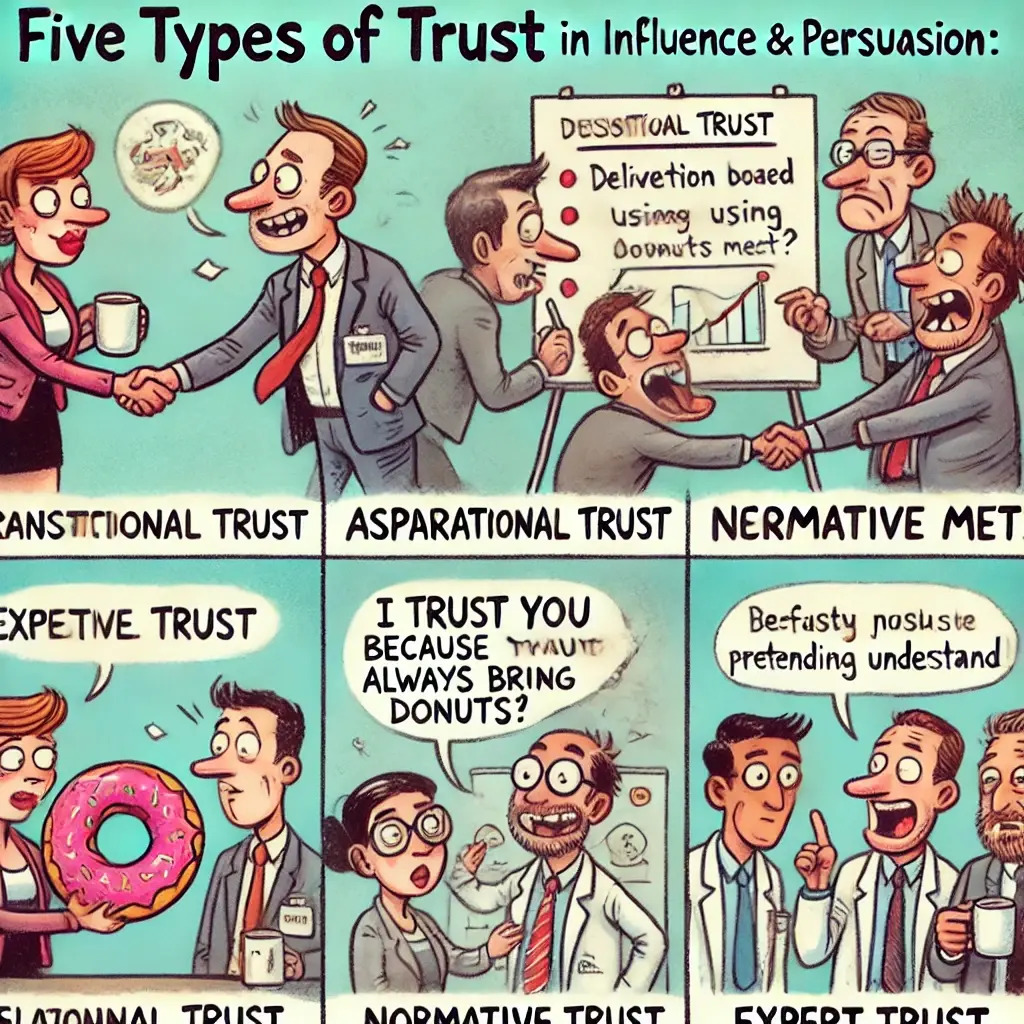
Trust may be: transactional, aspirational, relational, normative or expertise based
-
Successful influencers are those best at adapting to the needs of the situation
-
Determine the type of trust required for a specific interaction and use material that enhances it
A Common Reason Many Attempts At Influence Fail
We all know trust matters, but the type of trust you need to build directly depends on the dynamics of the relationship you have and the one you’re trying to achieve. I’ve watched countless individuals apply a pattern that previously worked with someone else only to have it fall flat because they hadn’t aligned their actions with the specific type of trust they required from the other person.
Trust is contextual and different relationships require different types of credibility. Focus on the right type of trust for your specific influence context.
Transactional Trust: The Reliability Factor
Common Scenarios: Client-vendor relationships, project management, sales relationships, service delivery contexts, and any situation where specific deliverables or outcomes are expected.
Researchers from the University of Southern California found that consistent delivery of promised outcomes creates what they call “calculus-based trust”—a foundation for business relationships based on reliability and predictability.
Research insight: A PwC study found that 71% of consumers cite reliability as more important than price when selecting vendors for ongoing relationships.
How to leverage this:
-
Track and communicate your reliability metrics.
-
Implement what organizational psychologist Amy Edmondson calls “structured transparency” – regular visibility into processes and progress
-
Use expectation management techniques
-
Consider using quality & service guarantees
Trust hack – The Preemptive Recovery: Before a project begins, document the three most common failure points and your exact recovery protocol for each. When shared with stakeholders, research shows this actually increases initial trust by 23% compared to simply promising success, as it demonstrates both foresight and resilience planning.
Trust hack – Aspirational Metrics & Borrowed Metrics: Don’t yet have actual or useful metrics to share? You can gain the benefit of this type of trust by sharing aspirational standards – ‘We return all calls within 24 hours,’ ‘We have a 23 day action plan to sell your house,’ ‘Our ratio of customer service staff to clients is 14 to 1’.
You can also borrow metrics if appropriate. ‘We only work with insurance companies that publish their claims rates and h 90% or more of claims within 90 days.’
Real-world impact: Marriott’s Service Guarantee program, which promised specific compensation for service failures, contributed to their industry-leading customer satisfaction scores while providing valuable operational feedback
Relational Trust: The Connection Component
Most applicable to: Team environments, coaching relationships, long-term partnerships, customer service roles, healthcare provider-patient relationships, and collaborative projects.
Paul Zak’s research on organizational trust found that interpersonal connection significantly impacts team performance. His studies show that organizations with high-trust cultures report 74% less stress, 106% more energy, and 50% higher productivity.
Evidence-based finding: Researchers from the University of Michigan found that brief personal check-ins before problem-solving meetings improved solution quality by approximately 15%.
How to build relational trust:
-
Implement “high-quality connections” as researched by Jane Dutton at Michigan Ross School of Business– Dutton defines these as brief interactions characterized by mutual positive regard, active engagement, and felt energy that leave both parties feeling valued and capable.
-
Practice the balanced feedback approach developed by Gottman Institute researchers (more positive than negative interactions) – Maintain at least a 5:1 ratio of positive to negative interactions, ensuring critique is specific and behavior-focused while appreciation is genuine and attribute-focused.
-
Create psychological safety through appropriate self-disclosure, which research shows increases perceived trustworthiness.
Trust hack – The Deliberate Vulnerability Exchange: In new relationships, share a small, appropriate professional challenge you’re currently working to overcome, then ask for their perspective. This technique, studied by relationship researchers, creates what they call “vulnerability reciprocity”—making others 58% more likely to trust you with their own authentic concerns rather than maintaining a protective facade.
Market evidence: Zappos built its entire customer service model around personal connection, with no call time limits and representatives encouraged to build rapport. This approach contributed to their 75% repeat customer rate, significantly above industry average. You can read more about this in the book Delivering Happiness.
Normative Trust: Group Identification
Most applicable to: Cross-functional teams, new team members, cross-cultural collaborations, community organizing, marketing to specific demographics, and situations requiring acceptance from established groups.
Normative trust is the expectation that others will behave ethically and fulfill obligations because of social norms and shared values. Note that the norms and shared values may be real or perceived. Certain groups exist almost exclusively due to normative trust – the Hawala Money Transfer System, Amish Business Networks, Hutterite Colonies in North America and the Masai livestock sharing systems are all examples of groups whose economic functions are largely due to high normative trust.
Social identity research demonstrates that people trust those they perceive as group members substantially more than outsiders, regardless of objective credentials.
Research finding: Establishing common ground before introducing novel ideas increases acceptance rates by approximately 20%, according to persuasion research by Cialdini.
How to establish normative trust:
-
Employ the common ground technique identified in negotiation research
-
Practice cultural adaptation strategies developed in cross-cultural management studies
-
Demonstrate authentic group membership through shared language and experiences
Trust hack – The Insider-Outsider Paradox: Strategically position yourself as both an insider (through shared experiences or values) and as having a valuable outsider perspective. Research on innovation adoption shows that people most readily accept new ideas from those they perceive as “one of us” who also brings fresh insights precisely because of their unique background. This balanced positioning increases influence effectiveness by approximately 30% compared to either pure insider or outsider positioning.
Real-world applications:
When onboarding new employees sharing company values and education about the culture helps new hires integrate faster and gain team trust.
Influencer marketing, whether from someone on YouTube or Nike hiring professional athletes is another example of this. Who can you get who is respected among your potential clients to endorse you?
Aspirational Trust: Values in Action
Harvard Business School research found that 58% of employees would trust a stranger more than their own boss, with “behavioral integrity” (consistency between words and actions) being the primary factor in leader trustworthiness.
Most applicable to: Leadership positions, mentoring relationships, public figures, role models, change management initiatives, and situations requiring cultural or behavioral shifts.
How to build aspirational trust:
-
Practice what leadership researchers call “vulnerable leadership“—acknowledging limitations while demonstrating competence.
-
Document and share genuine values-aligned decisions. Especially when these come at a cost one should find a way to discreetly highlight these decisions.
-
Utilize, suggest and discuss behavioral commitments rather than value statements
Trust hack – The Values Collision Story: You should have specific stories prepared about instances where your personal or organizational values were directly challenged due to the with financial or convenience incentives. Obviously these should be stories where your values won out and you did the right thing. Behavioral research shows that this specific type of narrative builds aspirational trust faster than general values statements because it demonstrates values-in-action under pressure.
Expert Trust: Demonstrated Competence with Humility
Most applicable to: Advisory roles, consulting relationships, technical leadership, specialized services, educational contexts, and situations requiring specialized knowledge or skills.
Research from Northwestern University found that experts who occasionally acknowledge knowledge limits are rated as more trustworthy than those who claim expertise across all domains.
How to demonstrate calibrated expertise:
-
Apply the “confidence calibration” principles from decision science research – or put another way, use nuance in your language to reflect how certain you are about specific information. Use language like, “highly likely,” “moderately confident,” etc. Studies show that professionals who accurately calibrate their confidence are seen as more credible and competent than those who express unwarranted certainty.
-
Use the knowledge-sharing frameworks developed at IDEO for communicating complex information to diverse audiences – IDEO, a leading design and innovation firm, emphasizes storytelling, visual thinking, and iterative dialogue to break down complex ideas into accessible insights. They suggest framing expertise in relatable narratives, using analogies, and fostering interactive discussions.
-
Practice intellectual humility – Acknowledge the limits of your knowledge when necessary. Research indicates that admitting uncertainty when appropriate enhances, rather than diminishes, perceived expertise. Thoughtful transparency fosters trust and positions you as a credible and reflective expert.
Trust hack – The Precision Response: When asked a question in your domain, first briefly acknowledge the complexity of the question, then provide an answer with unusually specific metrics or distinctions. Cognitive psychology research shows that precise answers (using exact numbers rather than round figures, and making subtle distinctions) are perceived as (up to 40% more) credible than generalized answers, even when they communicate essentially the same information.
Case study: Dr. Atul Gawande’s implementation of medical checklists—and his transparent discussion of his own surgical errors—helped build trust in safety reforms across resistant hospital cultures, ultimately reducing surgical complications by more than 35% in participating hospitals.
The Trust Integration Effect
Meta-analysis of organizational psychology research reveals that aligned trust-building approaches create multiplicative rather than additive effects on influence outcomes, making influence attempts significantly more likely to succeed. Or put another way trust grows exponentially so use multiple techniques in conjunction with each other to create the impression you deserve to be creating.